

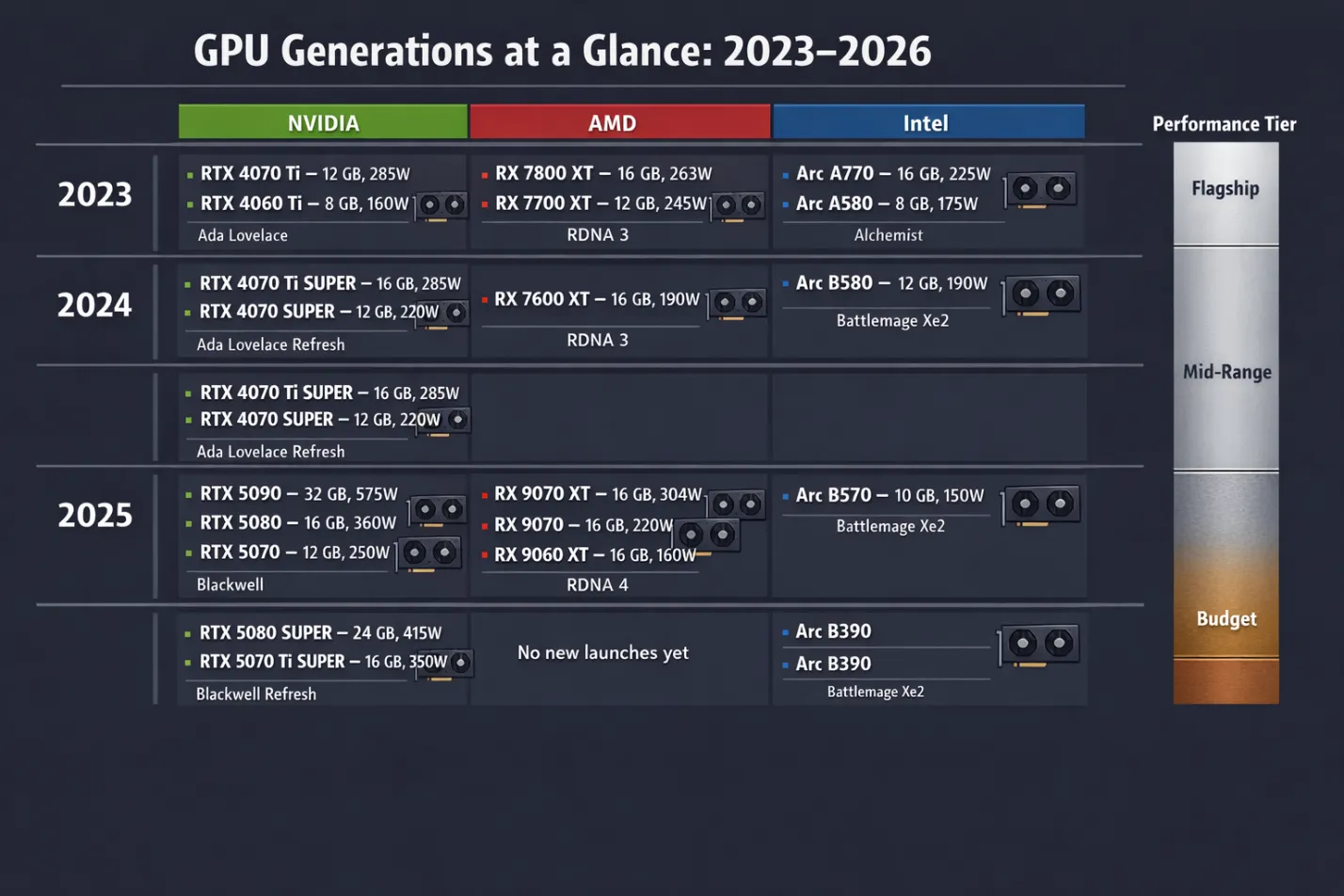
The GPU market has gone through a massive transformation between 2023 and 2026. Three manufacturers — NVIDIA, AMD, and Intel — are now shipping competitive products across every price segment, from budget 1080p cards to absolute flagship monsters. Whether you're building a new rig or upgrading an aging system, understanding what each generation brought to the table helps you make a smarter purchase.
This guide breaks down the most important graphics cards released each year, compares their architectures and real-world performance, and points you to detailed GPU benchmarks and specs on FPSBench so you can make data-driven decisions.
2023: The Year Mid-Range Got Serious
2023 was the year NVIDIA and AMD filled out their product stacks with cards that actually made sense for most gamers. The flagships had already landed in late 2022, so 2023 was all about the mid-range and upper-mid-range.
NVIDIA GeForce RTX 40 Series (Mid-Range Expansion)
NVIDIA's Ada Lovelace architecture continued its rollout with several key models:
- The NVIDIA GeForce RTX 4070 Ti launched in January 2023 with 12 GB VRAM and 285W TDP. It delivered performance close to the previous-gen RTX 3090 at a fraction of the power draw — a genuine generational leap for the $799 segment.
- Mid-year brought the RTX 4070, which quickly became one of the most popular cards of the generation. At 200W and 12 GB of VRAM, it handled 1440p gaming with ease. You can check its full specs here: https://fpsbench.com/gpu/nvidia-geforce-rtx-4070
- The GeForce RTX 4060 Ti and RTX 4060 rounded out the lineup for 1080p gamers, though the 8 GB VRAM on the base 4060 Ti drew criticism even at launch.
AMD Radeon RX 7000 Series (RDNA 3)
AMD's RDNA 3 architecture brought chiplet-based GPU design to the consumer market for the first time:
- The AMD Radeon RX 7800 XT arrived in September 2023 with 16 GB of VRAM and 263W TDP. It became the go-to recommendation for 1440p gaming on a budget, consistently trading blows with the RTX 4070 while offering more memory.
- The Radeon RX 7700 XT slotted in below it at 245W with 12 GB VRAM — a solid option for gamers who wanted RDNA 3 performance without stretching their budget.
- Budget buyers got the RX 7600, an 8 GB card at 165W that handled 1080p gaming competently.
Intel Arc (First Gen Matures)
Intel's first-generation Arc Alchemist cards, including the Arc A770 and Arc A750, continued receiving driver updates throughout 2023 that significantly improved their performance and stability. The Intel Arc A580 also launched as a budget-friendly option. While not yet matching NVIDIA or AMD in raw rasterization, Intel proved it was serious about the discrete GPU market.
For a deeper look at how these GPUs compare in synthetic and gaming benchmarks, click here to browse the full GPU database.
2024: Refreshes, Super Variants, and Intel's Battlemage
2024 was a transitional year. NVIDIA refreshed its RTX 40 lineup with "Super" variants, AMD filled gaps, and Intel launched its second-generation Arc architecture.
NVIDIA RTX 40 SUPER Series
The Super refresh brought meaningful upgrades at the same price points:
- The RTX 4070 Ti SUPER bumped VRAM to 16 GB on a wider 256-bit bus — addressing the biggest complaint about the original 4070 Ti. At 285W, it became the card to beat for high-refresh 1440p gaming.
- NVIDIA's RTX 4070 SUPER offered a nice performance bump over the vanilla 4070 while keeping the same 220W power envelope and 12 GB VRAM.
- The RTX 4080 SUPER refined the 4080 formula with 16 GB VRAM and 320W TDP, though the price-to-performance improvement was more modest at the high end.
Intel Arc Battlemage (B-Series)
The real story of late 2024 was Intel's Arc B580. Built on the Xe2 architecture (codenamed Battlemage), this 12 GB card launched at just $249 and delivered performance competitive with the RTX 4060 while offering 50% more VRAM. It was widely praised as the best value GPU of the year. Intel's driver situation had improved dramatically compared to Alchemist, and features like XeSS 2.0 upscaling made the B580 a legitimate recommendation for budget builders.
The manufacturing behind these chips is worth noting — companies like Baidasy specialize in the precision plastic molding and metal enclosure fabrication that goes into everything from GPU cooler shrouds to the electronic enclosures housing server-grade graphics hardware. It's a reminder that the GPU ecosystem extends far beyond the silicon itself.
2025: Next-Gen Arrives — Blackwell and RDNA 4
2025 was a blockbuster year. Both NVIDIA and AMD launched entirely new architectures, and Intel continued expanding its Battlemage lineup.
NVIDIA GeForce RTX 50 Series (Blackwell)
NVIDIA announced the RTX 50 series at CES 2025 in January, with cards rolling out through the first half of the year. The Blackwell architecture brought 4th-gen RT cores, 5th-gen Tensor Cores, and DLSS 4 with Multi Frame Generation. All RTX 50 cards are manufactured on TSMC's advanced 4N (5nm-class) process.
The flagship NVIDIA GeForce RTX 5090 is an absolute beast — 32 GB of GDDR7 on a 512-bit bus, 575W TDP, and over 100 TFLOPS of FP16 compute. It launched at $1,999 and targets 4K gaming with ray tracing maxed out. Full benchmark data is available at https://fpsbench.com/gpu/nvidia-geforce-rtx-5090
- The RTX 5080 came in at 16 GB GDDR7 and 360W — a more practical high-end option at $999.
- GeForce RTX 5070 Ti and RTX 5070 targeted the enthusiast sweet spot with 16 GB and 12 GB VRAM respectively, priced at $749 and $549.
- The RTX 5060 Ti launched in April 2025 in both 8 GB and 16 GB configurations at 180W, bringing Blackwell to mainstream gamers.
- RTX 5060 followed in May with 8 GB GDDR7 at 145W.
- The budget RTX 5050 arrived in July 2025 at $249 with 8 GB GDDR6 and 130W TDP — the entry point into Blackwell gaming.
AMD Radeon RX 9000 Series (RDNA 4)
AMD took a different strategic approach with RDNA 4, focusing on the mainstream segment rather than competing at the absolute high end. All RX 9000 cards use TSMC 4nm process technology. AMD officially unveiled the lineup on their newsroom in February 2025.
- The AMD Radeon RX 9070 XT launched at $599 with 16 GB VRAM and 304W TDP. It features significantly improved ray tracing hardware and FSR 4 support, making it competitive with the RTX 5070 in many titles.
- Radeon RX 9070 came in at $549 with 16 GB and 220W — offering excellent 1440p performance. PCGamer named it the best overall GPU of 2026 for its price-to-performance ratio.
- The RX 9060 XT launched in June 2025 starting at $299 for the 8 GB model and $349 for 16 GB. It targets 1080p gaming with ray tracing enabled.
- The Radeon RX 9060 followed as an OEM-first product with 8 GB VRAM at 132W.
Intel Arc B570
Intel expanded Battlemage with the Arc B570, launching in January 2025 with 10 GB GDDR6 and 150W TDP. Priced below $200, it offered remarkable value for budget 1080p gaming. You can compare it against other budget GPUs at https://fpsbench.com/gpus
2026: Super Refreshes and What's Next
As of early 2026, the GPU landscape is being shaped by mid-cycle refreshes and new budget options.
NVIDIA RTX 50 SUPER Series
NVIDIA has begun rolling out Super variants of the RTX 50 series. The RTX 5080 SUPER bumps VRAM to 24 GB with a 415W TDP, while the RTX 5070 Ti SUPER gets 16 GB at 350W. The RTX 5070 SUPER increases memory to 18 GB at 275W. Reports suggest no entirely new NVIDIA gaming GPUs will launch in 2026, with the RTX 60 series potentially delayed to 2028. NVIDIA's next-gen "Feynman" architecture is expected to use TSMC's A16 (1.6nm) node.
For the latest specs and benchmark scores on all these cards, the FPSBench GPU comparison page is regularly updated.
Intel Arc B370 and B390
Intel continues filling out its Battlemage lineup with the Arc B390 and Arc B370 in 2026, targeting the ultra-budget segment. These join the B580 and B570 to give Intel a complete product stack from entry-level to mid-range.
The Manufacturing Backbone: TSMC and Precision Engineering
Every GPU discussed in this article relies on TSMC's semiconductor fabrication. NVIDIA's Blackwell uses the 4N (5nm-class) node, AMD's RDNA 4 uses 4nm, and Intel's Battlemage uses TSMC's N5 process. TSMC's 3nm and 5nm production lines are fully booked through 2026, with the company investing $45–50 billion in capital expenditure for next-gen nodes including N2 (2nm) and A16 (1.6nm).
The physical hardware that houses these GPUs — from server racks to desktop enclosures — requires equally precise manufacturing. Companies specializing in injection molding and precision mold design play a critical role in producing the plastic and metal components that make up GPU coolers, backplates, and enclosures.
How to Choose the Right GPU in 2026
Picking a graphics card comes down to your resolution target, budget, and the games you play. Here's a quick framework:
4K Gaming (No Compromises): The RTX 5090 remains unchallenged. The RTX 5080 SUPER is a more reasonable alternative if you don't need 32 GB of VRAM.
1440p High-Refresh: The RX 9070 XT and RTX 5070 Ti are the sweet spot. Both deliver excellent frame rates with ray tracing enabled.
1440p Value: The AMD Radeon RX 9070 offers arguably the best overall value in the current market. The RTX 5070 is its closest competitor.
1080p Budget: The Intel Arc B580 and RX 9060 XT are both excellent choices under $350. For even tighter budgets, the RTX 5050 at $249 is the Blackwell entry point.
Still Solid from Previous Gens: Don't overlook the RTX 4070 SUPER or RX 7800 XT on the used market — both remain capable 1440p cards.
To compare any of these cards side by side with real benchmark data, head over to https://fpsbench.com/gpus
The Bigger Picture
The GPU industry between 2023 and 2026 has been defined by three trends: the rise of AI-accelerated upscaling (DLSS 4, FSR 4, XeSS 2.0), the shift to GDDR7 memory, and Intel's emergence as a genuine third competitor. NVIDIA continues to dominate the high end, AMD owns the value mid-range, and Intel is carving out the budget segment.
What hasn't changed is the importance of the broader supply chain. From TSMC's fabs producing the silicon to NVIDIA's architecture innovations, from AMD's chiplet designs to Intel's Xe2 cores — and all the way down to the precision manufacturing of the physical components that house these GPUs — every link in the chain matters.
For the most up-to-date GPU specs, benchmarks, and head-to-head comparisons, FPSBench maintains a comprehensive database covering hundreds of desktop and mobile graphics cards across all three manufacturers.
Post time: Apr-01-2026